
Bushwacker Pocket Style Fender Flares
Our Pocket Style fender flares combine aggressive bolt-on styling with serious wheel-well protection. The signature rivet design and textured finish deliver that rugged off-road look while shielding your truck’s paint from rocks, mud, and road debris. Each set is molded from our proprietary Dura-Flex 2000 material — a UV-resistant TPO compound engineered to flex on impact without cracking, then return to its original shape.


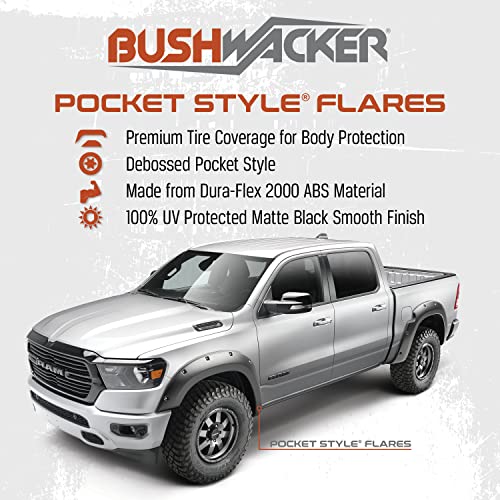


We manufacture every set of bushwacker pocket style fender flares from Dura-Flex 2000, a thermoplastic olefin formulation we developed specifically for automotive exterior use. This material offers superior impact resistance compared to ABS or fiberglass — when a rock strikes the surface, the flare flexes to absorb energy rather than shattering. Laboratory UV exposure testing confirms the compound retains its structural integrity and color stability after 2,000 hours of simulated sunlight, equivalent to several years of daily outdoor exposure.
Vehicle-Specific Fitment Engineering
Our design team creates a unique flare profile for each truck and SUV model we support. We start with 3D scans of factory bodywork to map every contour, mounting point, and clearance requirement. Ford F-150 kits account for differences between SuperCrew and SuperCab bed lengths, while Ram 1500 applications include specific brackets to work around factory air-dam hardware. This level of model-year precision eliminates the gaps and misalignment common with universal-fit products.
Mounting templates and pre-drilled pilot holes are positioned to align with factory crush zones and structural reinforcements, never placing fasteners through unsupported sheet metal. On vehicles that require drilling, our instructions specify exact locations that avoid wiring harnesses, brake lines, and other hidden components.
Coverage & Tire Clearance
Standard Coverage
Our Pocket Style flares add approximately 1.5 to 2 inches of fender extension beyond the factory wheel opening, measured at the widest point of the arch. This coverage accommodates tire sizes up to 35 inches on most full-size trucks without requiring suspension lifts or body modifications. The extension wraps around the leading and trailing edges of the wheel well to protect paint during sharp turns when oversized tires reach maximum steering lock.
Max Coverage Options
For trucks running 37-inch tires or wider wheel spacers, we offer Max Coverage Pocket Style variants that extend an additional inch. These wider flares use the same bolt pattern and material composition but feature a broader arch profile to maintain legal tire coverage in states with strict projection regulations.
Key specs & materials
Pocket Style Flares for Popular Truck Models


Customer reviews


Common Questions About Pocket Style Fender Flares
We engineer vehicle-specific kits for most popular trucks and SUVs from 1999 to current model years. Each application includes unique mounting brackets and flare profiles designed around that vehicle’s exact body contours and factory mounting points. When you select your make, model, year, and cab/bed configuration on our site, the system displays only kits confirmed to fit your vehicle. Fitment data accounts for mid-year production changes and trim-level variations that affect body panels.
Installation requirements vary by vehicle. Many applications use existing factory holes and clips for a true no-drill installation. Others require drilling 4 to 6 new pilot holes per flare — we provide adhesive paper templates that show exact drilling locations and our instructions specify drill bit sizes. The bolt-through design creates a more secure attachment than adhesive-only systems, particularly important for flares that extend coverage over larger tires.
Standard Pocket Style flares extend approximately 1.5 to 2 inches beyond the factory wheel opening at the widest point of the arch. This measurement varies slightly by vehicle model based on original equipment fender shape. The extension provides clearance for tires up to 35 inches in diameter on most full-size trucks. For applications requiring greater coverage, our Max Coverage variants add an additional inch of projection.
Yes, the Dura-Flex 2000 material accepts automotive paints after proper surface preparation. Scuff the flare surface with 320-grit sandpaper to create mechanical adhesion, then apply a flexible urethane primer designed for bumper covers and plastic trim. Use paint products formulated for flexible substrates — standard automotive primers and paints may crack when the material flexes. Many body shops recommend spray-on bed liner as an alternative that bonds exceptionally well and adds impact resistance.
Most installations require only basic hand tools: a drill with appropriate bits if new holes are needed, socket set or wrenches for bolt installation, measuring tape, and masking tape for template placement. A second person helps with initial positioning before fastening. We include all necessary hardware — stainless steel bolts, washers, backing plates, and detailed instructions with torque specifications. Plan for 2 to 3 hours of installation time for a complete four-flare set.
The Dura-Flex 2000 formulation is engineered for temperature extremes from -40°F to 140°F without becoming brittle or warping. UV stabilizers prevent sun-induced fading and chalking even in high-altitude or desert climates. The material’s impact-flex properties absorb energy from rock strikes and trail debris, returning to original shape rather than shattering like rigid ABS. Our limited lifetime warranty covers cracking, warping, and structural failures under normal use conditions.
Pocket Style flares are designed to meet or exceed tire coverage requirements in states that regulate projection beyond fender lines. The extension wraps around the front and rear edges of the wheel opening to maintain coverage during steering lock and suspension articulation. When properly sized for your tire diameter and wheel offset, these flares provide the legal coverage needed. Verify your state’s specific projection limits and tire width regulations before selecting standard or Max Coverage variants.